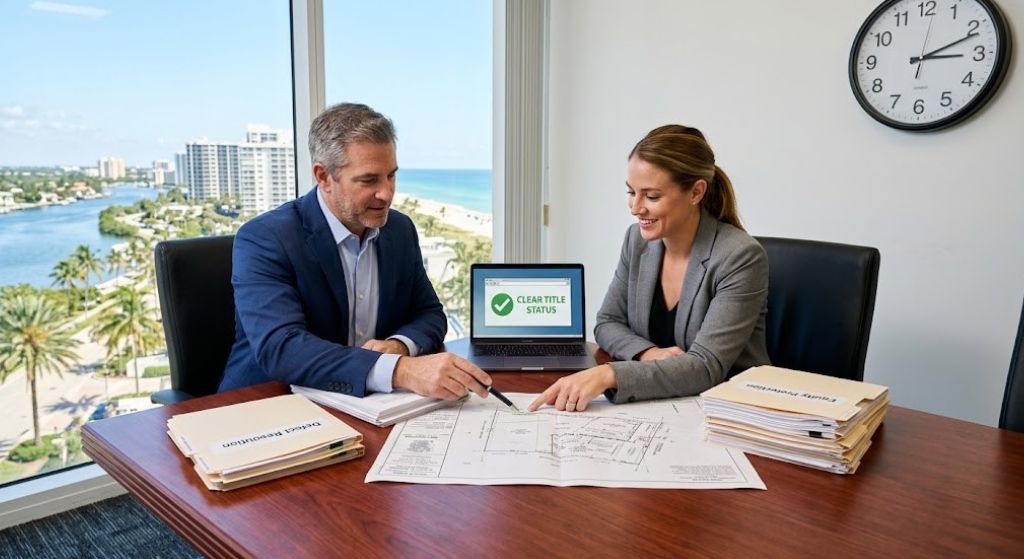
Title defect resolution is not a box to check at the end of a closing file. It is the work that keeps a good transaction from turning into a legal and financial mess. When you are buying in Florida, especially with investment timelines, luxury property, or a 1031 exchange, you need to find problems early, cure them cleanly, and walk into closing with insurable title.
Prerequisites: What You Need Before You Start
Before you can fix a title problem, you need the right paper trail. Title defect resolution starts with records, not assumptions, because a seller’s memory is never as reliable as the public record. In Florida, that matters even more when the property sits in an HOA, includes prior refinancing, or is part of a like-kind exchange structure that leaves no room for delay. For a broader view of the closing sequence, the Florida closing checklist helps you see how title work fits into the rest of the transaction.
Key documents to gather
Start with the contract, the title commitment, prior deeds, mortgage payoff statements, survey, HOA or condo documents, and any probate or estate paperwork tied to prior ownership. If the deal is an exchange, add the intermediary instructions and timing records tied to the replacement property. These are the documents that expose the real problems, especially in residential purchases where the title search often uncovers items no one mentioned at the start.
Who should be involved
You need your title agent, real estate attorney, lender, closing officer, and surveyor aligned from day one. If the chain of title shows a deceased owner, missing heir, or prior lawsuit, probate or litigation counsel belongs in the loop immediately. That is where VIP title services earn their value, because coordination is not an afterthought, it is the cure.
What a title search and title commitment reveal
A title search is the investigation. A title commitment is the insurer’s written list of what must be cleared before coverage issues. The final title policy is the protection you receive after closing. Together, these reports expose liens, breaks in ownership, legal description errors, easements, unreleased mortgages, and other defects that block a clean transfer. A proper real estate title search is the starting point for any serious closing.
Step 1: Order the Title Search Early
Speed matters because every day you wait is a day you lose for curative work. About 25% of real estate transactions have title problems that need correction before closing, and some industry estimates place complex title issues much higher. Early review gives you time to fix the file instead of arguing at the closing table.
Request the search as soon as the contract is signed
Order the search the moment the contract is executed. Do not wait for lender underwriting or a date confirmation. Early ordering gives you room to chase payoffs, correct records, and resolve surprises without pressure. In a normal residential file, a search can take a few hours to two weeks, and complex properties take longer.
Review the chain of title for breaks or gaps
Look for missing deeds, skipped transfers, inconsistent names, and prior owners who never properly conveyed title. A chain-of-title break is not cosmetic. It can stop title insurance from issuing and it can block marketable ownership. If the record does not show a clean path from one owner to the next, treat it as a legal defect until cured.
Confirm whether you are dealing with a residential purchase or a 1031 exchange
A standard home purchase tolerates some back and forth. A 1031 exchange does not. Deadlines drive the deal, and title defects can destroy the tax plan if you miss them too late. If you are buying replacement property, the 1031 timeline should be reviewed alongside the title file, not after it. For exchange buyers, time is leverage and also the enemy.
Step 2: Identify the Exact Type of Title Defect
Do not fix the wrong problem. Title defect resolution works only when you identify the source of the defect with precision, because liens, heir claims, clerical errors, and boundary disputes need different cures. A fast label leads to a bad solution.
Liens, judgments, and unpaid obligations
Start with tax liens, HOA balances, contractor claims, judgments, and unreleased mortgages. These are the most common money-based defects, and most are cured through payoff, settlement, or recorded release. In Florida closings, closing cost allocation and payoff handling often determine whether the file clears on time. The fix is usually procedural, but the release must be recorded, not merely promised.
Errors in public records or legal descriptions
Misspelled names, bad parcel numbers, wrong vesting language, and inaccurate legal descriptions create clouds on title even when everyone agrees on ownership. Clerical mistakes travel through the record and become real legal problems. The correction usually requires a corrective deed, amended affidavit, or re-recording of the affected instrument. Small error, serious consequence.
Probate, heirs, and ownership disputes
Missing heirs, undisclosed spouses, and deceased owners create direct title risk. If a prior owner died without proper administration, the property may not have passed cleanly. That gap requires probate review, and sometimes a quiet title action or heir release. These cases are not rare, and they are exactly where tailored litigation support matters. Llaudy Law handles these defects with both transactional discipline and courtroom readiness, which is the right mix when the record is not cooperating.
Fraud, forgery, and deed theft
Forgery and deed theft are rising problems. A 2025 NAR survey found 63% of real estate professionals had heard of title fraud or deed theft in their markets during the prior year, with awareness highest in the Northeast at 92%. If the signature history, identity records, or deed sequence looks suspicious, escalate immediately. Fraud does not get fixed by optimism.
Boundary, survey, and easement problems
Survey defects show up as encroachments, overlapping improvements, access disputes, or undisclosed easements. A shed over the line, a driveway crossing the wrong parcel, or an easement nobody disclosed can all block a clean closing. Survey review tells you whether the issue affects marketability, lender approval, or insurance coverage. Boundary disputes are often curable, but only after you know exactly where the line is.
Step 3: Evaluate Severity and Closing Impact
Not every defect has the same effect. Some issues delay closing for a day or two. Others stop funding, stop insurance, and stop the deal. Your job is to separate paper problems from closing-stopping defects.
Determine whether the defect blocks insurability
Title insurers care about risk, not excuses. If the defect creates uncertainty about ownership or enforceability, the insurer can refuse to issue the policy until the problem is cured. Clear title means the property is transferable, insurable, and defensible. It does not mean someone signed a contract and hoped for the best.
Identify which issues the lender will not fund over
Lenders will not close over unreleased mortgages, unresolved judgments, or ownership uncertainty. Mortgage-backed deals live or die on underwriting conditions, and unresolved title issues are one of the fastest ways to lose funding at the finish line. That is why lender communication matters early, not after a release is overdue.
Separate curable issues from litigation-level disputes
Some defects disappear with a payoff or corrected deed. Others require a court order. If the issue involves competing claims, missing heirs, fraud, or a dead-end record, you are in quiet title, probate, or declaratory judgment territory. At that point, transaction work alone is not enough. You need litigation strategy that supports closing instead of delaying it.
Step 4: Resolve Financial Claims and Payoff Issues
Most closings are delayed by money claims that should have been cleared earlier. The fix is rarely dramatic. It is disciplined payoff tracking and proof of release.
Obtain accurate payoff statements
Get final mortgage figures, lien balances, HOA estoppels, and any transfer-related charges in writing. Incomplete payoff data is one of the most common causes of closing delay, because the title file cannot clear until the numbers are exact. The best cure is a confirmed payoff package, not a verbal estimate.
Release or satisfy existing liens
Pay the claim, then confirm that a satisfaction or release is recorded. Payment alone is not enough. If the release does not hit the public record, the defect survives the closing and follows the property into the next ownership cycle. That is how routine cleanup turns into a post-closing dispute.
Handle HOA, condo, and association balances
Florida association files deserve special attention. Unpaid dues, special assessments, and transfer fees often appear late, and estoppel statements control the final numbers. Nearly 57% of title professionals report HOA dues or transfer fees as part of the clearance burden, so treat association review as a core closing task, not a side issue.
Step 5: Correct Document and Record Errors
When the issue is clerical, fix the paperwork. Fast. Record errors do not heal on their own, and they do not disappear because closing is near.
Amend or re-record faulty documents
Use corrective deeds, affidavits, or re-recorded instruments to repair bad paperwork. The goal is simple: restore a clean public record that matches the deal. If the deed, mortgage, or release was recorded incorrectly, the cure must be recorded correctly too.
Fix name, marital status, and vesting errors
Names must match exactly. So must marital status and vesting language. A missing spouse, wrong middle initial, or bad vesting form can create a title exception that lasts beyond closing. Identity errors are easy to dismiss and expensive to ignore.
Resolve survey or legal description mismatches
A bad legal description can transfer the wrong parcel, leave out part of the land, or create overlap with a neighbor. Correcting the survey or reissuing the description removes the ambiguity before it becomes a post-closing fight. For high-value property, this step deserves the same attention as financing.
Step 6: Address Ownership, Probate, or Court-Based Issues
This is where title defect resolution becomes legal work, not just paperwork. When ownership history is broken, you cure the record through estate administration, sworn documentation, or court action.
Clear deceased-owner issues through probate
If a prior owner died, title may remain frozen until the estate is properly administered. The personal representative, heirs, and estate documents must align before conveyance can proceed. Without that alignment, the buyer does not receive clean title, no matter how ready the closing table looks.
Use affidavits, releases, or corrective instruments when appropriate
Some defects are cured by sworn statements or limited releases. Others require corrective deeds or settlement documents. The right cure depends on the record history, the defect type, and what the insurer will accept. This is where precision matters. A weak affidavit does not fix a strong defect.
File quiet title or other court actions when needed
When the record cannot be cleaned by documents alone, file suit and get a final order. Quiet title actions are often the cleanest path for boundary disputes, heir conflicts, fraudulent deeds, and ownership gaps that refuse to resolve by agreement. Llaudy Law’s litigation and transactional approach is built for exactly that kind of problem, because closing does not wait for a theory. It waits for a cure.
Step 7: Coordinate with the Title Company, Lender, and Closing Team
A cured defect still has to make it through the closing pipeline. That means constant coordination and no assumptions.
Track cure deadlines and closing conditions
Put each defect on a written cure list with a deadline, a responsible party, and a required document. That simple discipline prevents hidden delays. If a release, corrective deed, or court order is late, you need to know immediately, not the morning of closing.
Confirm what must be satisfied before the title commitment can be updated
The commitment will not change until the insurer sees proof of cure. Once the defect is fixed, the file must be updated, exceptions revised, and any endorsements confirmed. In one 2025 dataset, 42% of title defects found at closing were unknown to the seller, which is exactly why independent verification beats confidence.
Keep the lender informed when financing is involved
Lenders need real updates, not vague reassurance. If a payoff is pending or a release is still in transit, underwriting needs to know. Silence creates funding risk, and funding risk creates closing risk. Title work and lender approval have to move together.
Step 8: Secure the Right Title Insurance Protection
Title defect resolution ends with insurance that reflects the cured record. If the policy is wrong, the job is not finished.
Understand owner’s title insurance versus lender’s title insurance
Lender coverage protects the lender. Owner’s coverage protects your equity and your ownership rights. If you are buying residential property or an investment asset, you need owner’s title insurance, not just the lender’s policy. National data shows buyers often pay about 0.42% of purchase price on average for title insurance, and that cost is small compared with a defect that survives closing.
Review endorsements and exception language closely
Do not skim the exceptions. If a survey issue, easement, lien, or probate concern remains in the policy, the coverage is not doing enough. Endorsements should match the actual risk you faced and the cure you obtained. That is especially important in luxury and exchange transactions, where the loss exposure is larger.
Ask about discounts, fees, and high-value transaction handling
Price matters, but service quality matters more. A cheap title policy does nothing if the file is mishandled. In high-value closings, you need attention to detail, bilingual communication when required, and fast response to record defects. That is the standard you should expect from a team built for complex closings and high-touch service.
Troubleshooting: Common Problems That Delay Title Defect Resolution
The same issues cause trouble again and again. If you spot them early, you can keep the closing alive.
Missing payoff information from a prior lender
Old mortgages and unreleased loans create stubborn delays. If the lender is slow, push for written payoff confirmation and recorded release tracking. Do not assume a paid loan equals a cleared record.
Seller did not disclose the defect
Do not rely on seller disclosure as a substitute for a title search. A 2025 dataset found 42% of title defects at closing were unknown to the seller. Independent review is the only reliable protection.
Probate or heir documents are incomplete
If estate authority is missing, the file stops. Get the probate paperwork right before signing. A half-finished heir file is not a cure, it is a delay.
Survey reveals an encroachment or easement conflict
When a survey shows overlap or access issues, negotiate the fix, amend the record, or take the matter to counsel. Unresolved boundary problems do not belong at closing.
Fraud indicators appear during the search
Treat suspicious signatures, deed jumps, and identity mismatches as emergencies. Fraud claims need immediate legal action, not a waiting period. Title insurers paid $596 million in claims in 2022, and 21% involved fraud or forgery. That number is not abstract when your deal is on the line.
Expected Outcome: What Clear Resolution Looks Like Before Final Closing
When title defect resolution is done correctly, the file becomes boring in the best possible way. The insurer is satisfied, the lender is satisfied, and the record supports the transfer.
You receive clear, insurable title
You should have a file that can be insured without unresolved exceptions tied to the defect. That is the real standard. Ownership that is clean on paper and defensible in practice.
Your closing proceeds without last-minute legal surprises
Early curative work protects your timeline, your financing, and any exchange deadline tied to the deal. It also keeps post-closing disputes from circling back later. That matters even more where foreign buyer rules or exchange structures add compliance layers.
Your next step is final document review and closing
Once the defect is cured, review the settlement statement, title commitment, and final policy language before signing. That final pass is where you catch missed exceptions and confirm the cure actually made it into the file.
Frequently Asked Questions
How long does title defect resolution usually take?
Simple payoff and release issues move fast. Probate, heir disputes, fraud, and boundary conflicts take longer because they require documents, negotiation, or court action. The timeline depends on the defect, but early search and immediate cure work always shorten the process.
Can you close with a title defect still unresolved?
No, not if you want insurable, marketable title. Some defects delay the closing table for a short time, and others stop the closing completely until the issue is cured.
What is the most common title defect in Florida closings?
Unreleased mortgages, HOA balances, recording errors, and ownership gaps show up often. Fraud-related defects are also rising, which is why independent title review matters even when the seller says everything is fine.
Does owner’s title insurance cover defects discovered after closing?
Yes, if the issue falls within the policy and is not excluded. That coverage is designed to protect your ownership interest after closing, which is exactly why it belongs in serious residential and investment purchases.
Why do boundary disputes need legal help?
Because a survey problem is not just a mapping issue. It can affect marketability, access, insurance coverage, and future sale value. Boundary defects often need negotiation, corrective documents, or a court order.
When should you involve a real estate attorney instead of only a title company?
Bring in counsel as soon as the defect involves probate, fraud, a disputed claim, or a lawsuit-level issue. A title company can flag the defect, but legal cure strategy belongs with an attorney who can handle both the transaction and the litigation side of the problem.
Title defect resolution is not about hoping the file clears. It is about proving that it will. When the record is clean, the insurer is satisfied, and the closing team is aligned, you move from risk to certainty with far less drama.
This article is for informational purposes only and does not constitute legal advice. Accreditation requirements vary by state and payor contract. Consult with a qualified attorney regarding your specific compliance obligations.